

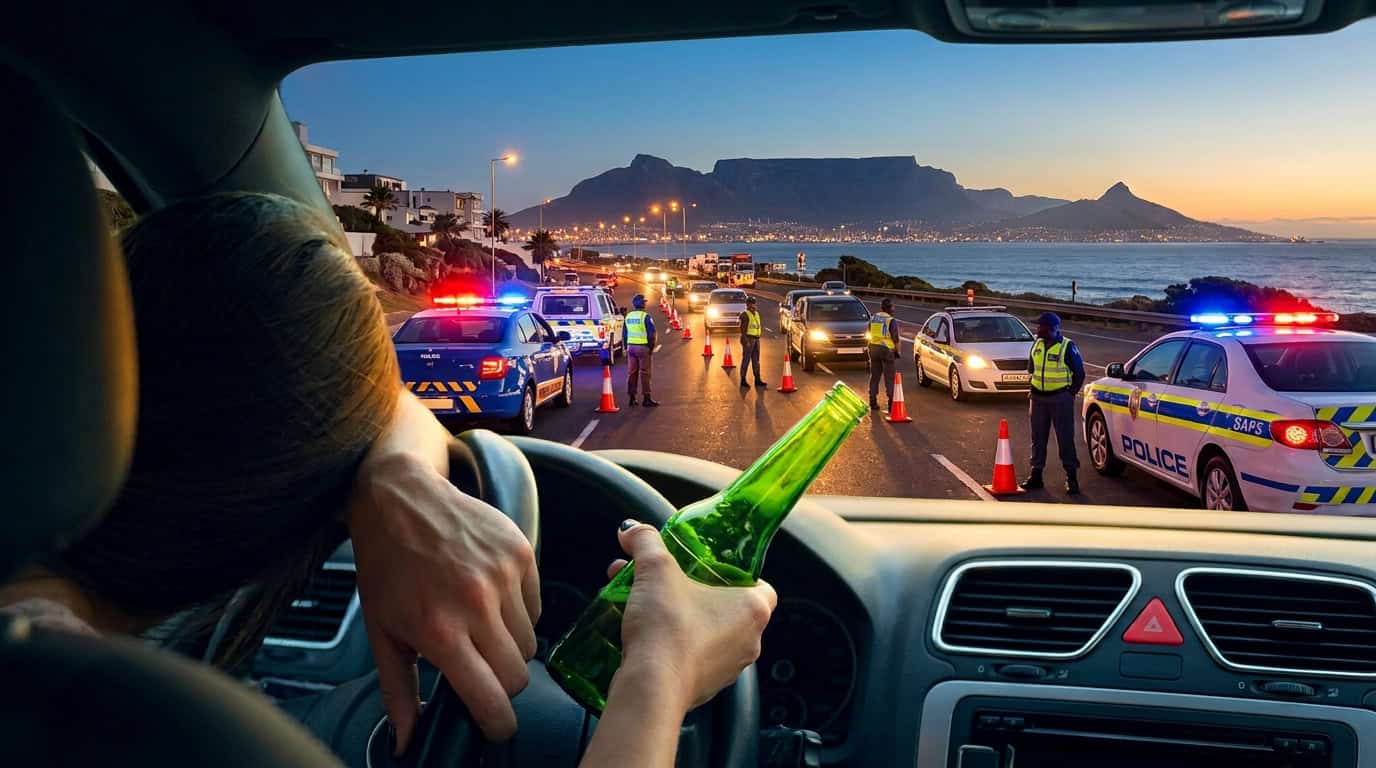
The Real Risks and What You Need to Know
Having a few drinks and then getting behind the wheel can have serious consequences in South Africa.
During holiday periods, long weekends and other busy times on the roads, traffic authorities often increase roadblocks and alcohol testing. But what does the law actually say about drinking and driving, and what happens if you are stopped or arrested?
Here is what South African motorists need to know.
What Does the Law Say About Alcohol and Driving?
South Africa’s National Road Traffic Act 93 of 1996 deals with driving under the influence of alcohol and driving with an excessive concentration of alcohol in your blood or breath.
There are currently two important offences.
First, you may not drive, or occupy the driver’s seat of a vehicle while its engine is running, while under the influence of intoxicating liquor.
Second, the law sets maximum permitted alcohol concentrations for drivers.
The current statutory limits
For an ordinary driver, the relevant limits are:
- Blood: less than 0.05 grams of alcohol per 100 millilitres of blood.
- Breath: less than 0.24 milligrams of alcohol per 1,000 millilitres of breath.
For a professional driver, the limits are lower:
- Blood: less than 0.02 grams per 100 millilitres of blood.
- Breath: less than 0.10 milligrams per 1,000 millilitres of breath.
The Act prohibits driving where the concentration is not less than the applicable limit.
Importantly, there is no reliable rule saying that a particular number of beers or glasses of wine will keep you below the legal limit. Your alcohol concentration can depend on factors including how much you drank, how quickly you drank it, your body and whether you had eaten.
So don’t rely on statements such as “two beers are legal”. They are not a reliable way of determining whether you are legally fit to drive.
What About South Africa’s Proposed “Zero-Tolerance” Law?
You may have heard that South Africa is moving towards a zero-percent blood-alcohol policy.
There is an important distinction here.
As of 2026, the existing statutory alcohol limits in section 65 of the National Road Traffic Act remain in force. The Department of Transport has announced that it is pursuing amendments to move towards a zero-percent alcohol policy, but the proposed change is not the same thing as the law already having changed.
Traffic authorities may nevertheless use terms such as “zero tolerance” when describing enforcement campaigns against drinking and driving. That does not, by itself, change the statutory limits currently contained in the Act.
How Can Police or Traffic Officers Test You?
Law-enforcement officials can require alcohol testing in accordance with the National Road Traffic Act and the applicable procedures.
South Africa also has Evidentiary Breath Alcohol Testing (EBAT) facilities. For example, the Western Cape Government reported in March 2026 that it had operational EBAT centres and mobile units as part of its road-safety enforcement operations. (South African Government)
The law also provides for blood and breath specimens and contains specific rules about the timing of those specimens.
For example, where a blood or breath specimen meeting the statutory requirements is obtained within two hours after the alleged offence, the Act provides for a presumption concerning the person’s alcohol concentration at the time of the alleged offence, subject to evidence to the contrary.
This does not mean that every motorist will automatically go through exactly the same testing process at every roadblock.
What If You Are Stopped?
If you are stopped at a roadblock or by a traffic or police officer:
- Remain calm and polite.
- Follow lawful instructions.
- Provide your driver’s licence and other required documents.
- Do not argue with officers at the roadside.
- Make a note of the time and location of the stop.
- If you are arrested, ask what offence you are being arrested for.
- Remember that you have constitutional rights as an arrested and detained person, including the right to be informed of your rights and the right to consult a legal practitioner.
Do not assume that refusing an alcohol test will make the problem disappear. The National Road Traffic Act contains offences relating to refusing certain specimens.
What Happens If You Are Arrested?
If you are arrested, you will generally be taken into custody and processed in accordance with the Criminal Procedure Act.
The police must inform a detained person, as soon as reasonably possible, of the right to apply for bail. Depending on the offence and circumstances, bail may be dealt with under the provisions dealing with police bail, prosecutorial bail or bail before a court.
There is no rule that every person arrested for an alcohol-related driving offence will automatically be released on police bail. The circumstances and the applicable legal provisions matter.
How Long Can You Be Held Before Seeing a Magistrate?
This is an area where motorists often hear incorrect information.
The Constitution and Criminal Procedure Act generally require an arrested person who is not released to be brought before a lower court as soon as reasonably possible, but not later than 48 hours after the arrest.
There is an important qualification.
If the 48-hour period expires outside ordinary court hours or on a day that is not an ordinary court day, the person must be brought before a lower court not later than the end of the first court day.
This does not mean that weekends and public holidays simply stop the 48-hour clock from running.
The practical result can therefore depend on the exact time of arrest, when the 48 hours expires and whether the expiry occurs outside ordinary court hours. South African courts have confirmed this interpretation in recent cases.
What Happens at the First Court Appearance?
Being brought before a magistrate does not mean that you will automatically be convicted—or even that the matter will necessarily proceed immediately to trial.
At the first appearance, the court deals with the procedural position of the case, including issues such as the charge, detention and bail where applicable.
A DUI matter can take time to finalise, particularly where the State still needs evidence such as forensic results.
However, there is no automatic rule that a DUI case must be struck from the roll simply because a blood-test result is not yet available.
Similarly, if a matter is removed from the court roll, it should not be assumed that the charge has been permanently dismissed or that the accused has been acquitted. The consequences depend on the circumstances and the applicable court order and procedure.
What Happens If You Are Convicted?
A conviction for driving under the influence or driving with an excessive alcohol concentration can have serious consequences.
Under section 35 of the National Road Traffic Act, a conviction for the relevant alcohol-related offences can result in the suspension of a driving licence for minimum periods of:
- First offence: at least 6 months
- Second offence: at least 5 years
- Third or subsequent offence: at least 10 years
These periods are calculated from the date of sentence.
There is, however, an important qualification.
Section 35 allows a court, where the statutory requirements are met, and circumstances justify it, to order that the suspension does not take effect or that it operates for a shorter period.
So it is not accurate to say that every convicted driver will automatically lose their licence for exactly one of those periods regardless of the circumstances.
Can You Go to Prison?
Yes.
Section 89(2) of the National Road Traffic Act provides that a person convicted of certain offences, including the relevant offences under section 65, may face a fine or imprisonment for a period not exceeding six years.
That does not mean that every person convicted of drunk driving will receive a six-year prison sentence.
The actual sentence depends on the offence, the circumstances of the case, the accused’s previous convictions and the sentencing court’s assessment of the appropriate sentence.
Will a DUI Conviction Give You a Criminal Record?
A conviction can result in a criminal record.
However, it is incorrect to say that a DUI criminal record simply “lasts for 10 years” and then automatically disappears.
South African law provides for expungement of certain qualifying criminal records after the required period and subject to statutory requirements.
The Department of Justice explains that a person may apply for expungement where the relevant requirements have been met, including the expiry of the applicable 10-year period. Not every conviction qualifies, and factors such as the sentence imposed and subsequent convictions can affect eligibility.
In other words, 10 years is not an automatic expiry date for every criminal record.
Can Alcohol Be “Sobered Up”?
No.
Coffee, cold showers, energy drinks, food or fresh air may make you feel more awake, but they do not provide a reliable way to rapidly remove alcohol from your bloodstream.
The safest option after drinking is simple:
Don’t drive.
Give yourself enough time for the alcohol to leave your system, or use another form of transport.
What Should You Do If You Plan to Drink?
If you know you are going to drink, plan your transport before you start drinking.
You could:
- Use a ride-hailing service.
- Arrange a sober driver.
- Ask a family member or friend for a lift.
- Use public transport where appropriate.
- Stay overnight rather than driving home.
- Leave your vehicle where it is and collect it later.
Don’t try to calculate whether you’re “safe enough” to drive based on the number of drinks you’ve had.
The Bottom Line
South Africa’s current law still provides statutory alcohol limits for drivers, although the government is pursuing amendments aimed at moving towards a zero-percent policy.
But the safest approach is not to gamble with the legal limit.
If you’ve been drinking, don’t drive.
A night out is not worth a crash, an arrest, a criminal conviction, losing your licence—or hurting yourself or someone else.
We have practising criminal law attorneys who have extensive experience in police and after-hours bail applications.
Feel free to contact us should you, your loved one or your friend be faced with a charge of driving under the influence (DUI), reckless and negligent driving or any related charges.


Recent Comments